A life that is saved is a life worth living.
Grethe Lunde, one of the world's 9 million stroke survivors, shares her perspective on the importance of patient testimonies in the fight against stroke.
In this first article in the series "Echoes of the European Forum for Life after a Stroke", the Association for Stroke and Aphasia is pleased to introduce the Bulgarian public to the shared experience and scientific achievements presented at the European Forum for Life after a Stroke, held on 11 and 12 March this year in Dublin. Grete Lunde, a member of the forum's scientific committee and survivor of a stroke, provides us with a unique insight into her struggle and recovery.
Grethe faced the stroke 30 years ago, when she was just 22 years old. She emphasizes that every stroke experience is different and that survivors' personal stories can be a powerful tool to support and inspire others. According to her, evidence of recovery after a stroke should not be limited to scientific research. They should be expanded to encompass the personal experiences of survivors. She bases her thesis on the fact that stroke survivors can feel a change over time. Sometimes, as in her case, this can be a period of tens of years. In these cases, the most powerful tool is patience and the constant repetition of rehabilitation.
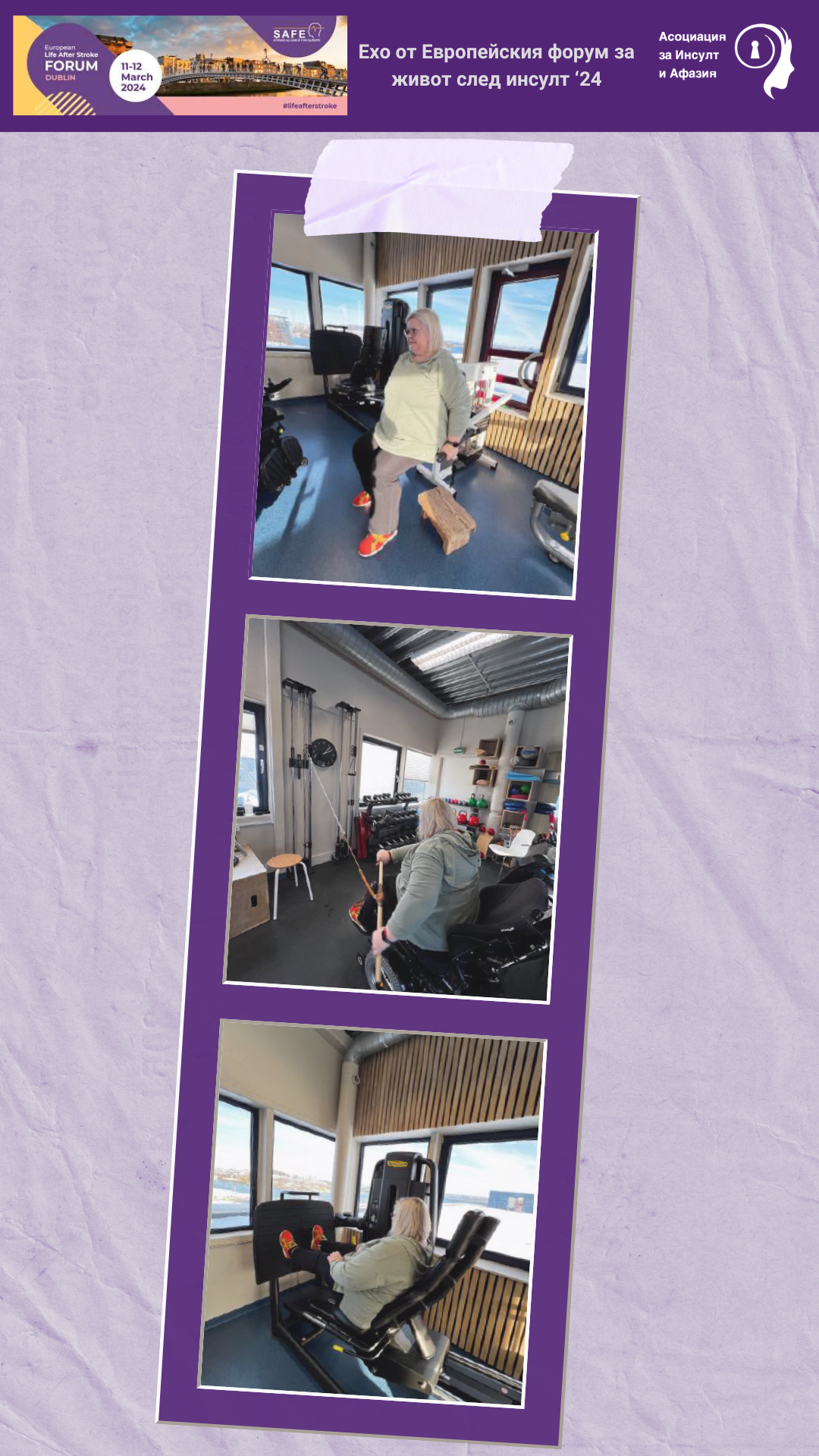
"Exercise for me personally is a source of endorphins, which leads to improved mood, pain relief and a sense of reward. At least an hour of heavy weightlifting and an increase in heart rate every week keep me at a stable level," she says about her motivation and methods for maintaining good physical condition. However, when experiencing fatigue and severe pain, a session of 5-10 minutes on a hand bike can be more than enough.
Grethe describes her struggle with pain and how her new "friend with benefits," the wheelchair, helped her maintain an acceptable level of energy and walk again without too much pain. She said she had used physical therapy from when she was in a coma until now, 30 years later. Now, as she turns back, she clearly remembers the severe pain that forced her to quit work at the age of thirty.
In conclusion, Grete leaves us with the message: "A saved life should definitely be a life worth living - and if nothing else seems to work - smile. Make stroke a priority in all aspects of life. Just do it."
This article is the first in the series "Echoes from the European Forum for Life after a Stroke". With it, we launch an initiative to present you with different perspectives and scientific achievements related to life after a stroke. The following publications will continue to explore the topic from different perspectives in order to raise public awareness and inspire our society for change.