

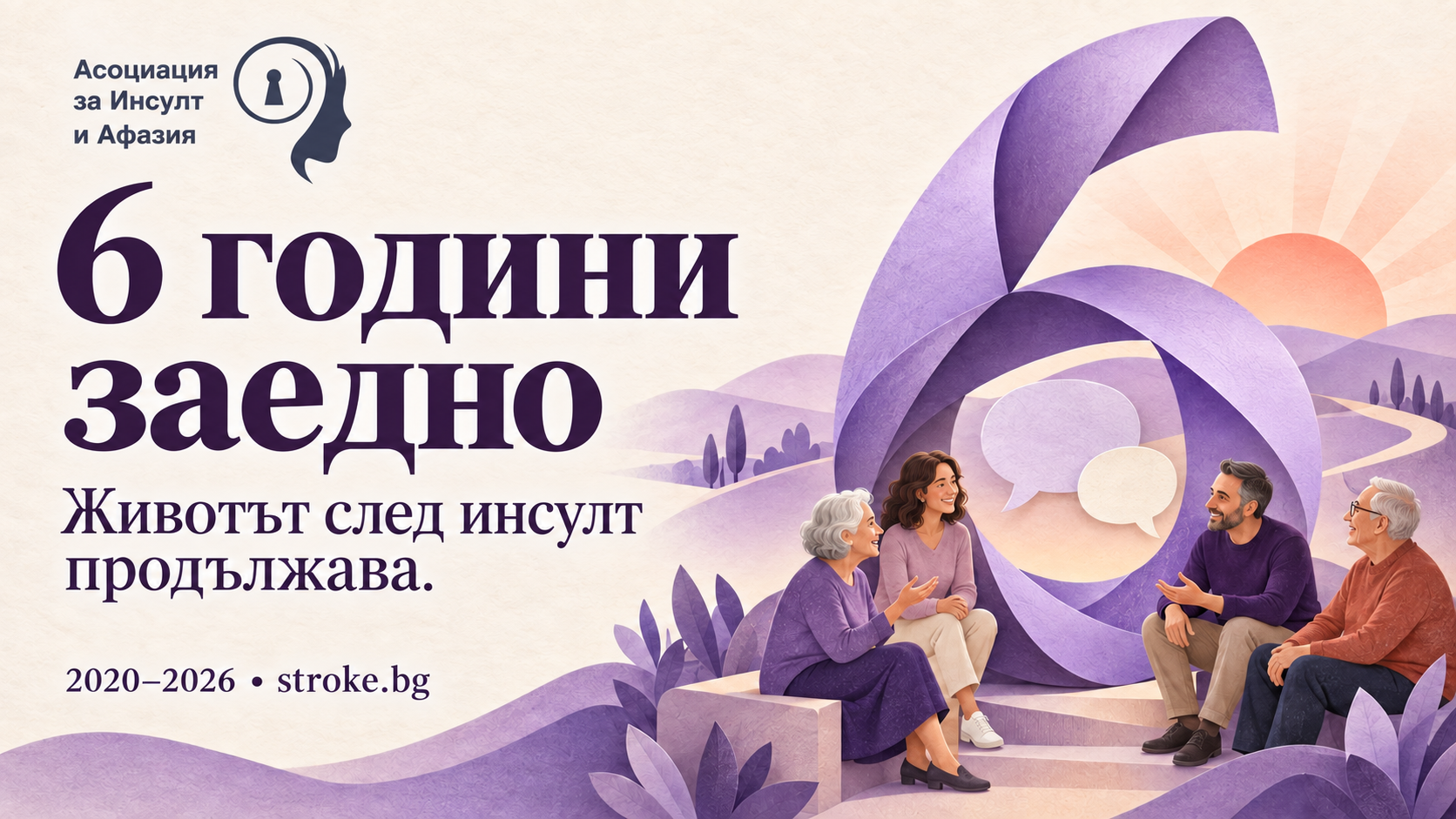
Six years together. Six years of working for greater awareness, timely action in the event of a stroke, and accessible support for those affected and their families.
Since its establishment in 2020, the Association For Stroke and Aphasia (ASA) has brought together patients, families, healthcare professionals, municipalities, institutions and international partners. We believe that the experiences and needs of people affected by stroke and aphasia should inform decisions about their treatment, recovery and participation in society.
Bringing the Patient Voice into National Decision-Making
In 2021, ASA initiated Bulgaria’s commitment to the Stroke Action Plan for Europe. The declaration of commitment was signed at the Ministry of Health on 8 December that year. This commitment established shared goals for prevention, treatment and long-term support. Our continuing task is to advocate for these goals to translate into concrete action.
In 2025, ASA established National Stroke Awareness Day on 11 November. The day brings patients, professionals, institutions and partners together to promote sustained action and provides an annual opportunity to assess progress and address outstanding challenges.
Knowledge That Reaches Communities
ASA works with all municipalities across Bulgaria. Together with our municipal partners, we run annual campaigns marking Brain Awareness Week in March, European Stroke Awareness Day in May and World Stroke Day on 29 October. Local events and educational activities make information more accessible and encourage community participation.
Through the “Path of Knowledge”, we share essential information about stroke in an accessible and engaging way. Our aim is to help people apply what they learn in real situations: recognising symptoms, seeking emergency assistance or supporting a loved one.
Practical Support After Hospital Discharge
ASA created Bulgaria’s first printed handbook for people affected by stroke and aphasia following discharge from a neurology department, and for their families. The handbook offers guidance at a time when families face unfamiliar challenges and need to organise care and recovery at home.
The Association also created the first Stroke InfoBot on Viber. With more than 3,500 users, the InfoBot makes information about suspected stroke easier to access and directs those affected to resources and support. If you suspect a stroke, call 112 immediately.
The handbook, InfoBot, support line and peer support groups share a common purpose: helping people affected by stroke and aphasia, and their families, find the information and assistance they need.
From Identifying Unmet Needs to Free Speech and Language Therapy
In 2024, ASA completed its first project identifying the unmet needs of people affected by stroke and aphasia within Sofia Municipality. Supported by the Municipality’s Europe Programme, the project provided a basis for solutions addressing the specific difficulties experienced by those affected and their families.
The research findings informed the Programme for Establishing Aphasia Speech and Language Therapy Centres, developed in 2025 in partnership with Sofia Municipality and Sofia University “St. Kliment Ohridski”. According to ASA, this is Europe’s first municipal programme providing free treatment for aphasia.
Since January 2026, the first two centres, located at Sofia’s 12th and 17th Diagnostic and Consultative Centres, have provided free speech and language therapy to residents of the capital. The programme envisages the phased establishment of ten centres by 2030. Access to specialist therapy supports the recovery of language skills and communication in everyday life.
Expanding Access to Robotic Rehabilitation
In March 2025, ASA launched the “Accessible Robotic Rehabilitation” initiative. Through public discussions and collaboration with specialists and the Institute of Robotics at the Bulgarian Academy of Sciences, the Association highlighted the need to make modern rehabilitation methods available to more stroke survivors.
ASA’s initiative contributed to an increase in the number of rehabilitation centres offering robotic rehabilitation. This approach enables more intensive movement training, tailored to individual needs and delivered under professional supervision. We continue to work towards wider access to this form of rehabilitation after stroke.
Bringing the Bulgarian Patient Voice Beyond National Borders
ASA’s international work creates opportunities to exchange knowledge and strengthen patient advocacy. Membership of SAFE, Aphasia International Association (AIA) and World Patients Alliance (WPA), participation in EACH activities and collaboration with Bulgarian Members of the European Parliament help bring the needs of people affected in Bulgaria to European and international attention. Meetings in Brussels form part of our efforts to ensure that the patient voice contributes to health policy discussions.
Our engagement with Bulgarian communities abroad includes an exhibition in Czechia, participation in the “Path of Knowledge” at the Bulgarian Secondary School “Dr Petar Beron” in Prague, visits to Bulgarian embassies and meetings with Bulgarians in Ireland, Norway and Poland. These initiatives help us share knowledge and build connections for support beyond Bulgaria’s borders.
Six Years of Shared Effort
We thank everyone who has shared their experiences, difficulties and hopes with us. We are grateful to families, volunteers, professionals, municipalities, donors and partners for their trust and collaboration.
Over six years, we have brought pressing issues to the attention of institutions, created practical support tools and helped develop new opportunities for therapy. We continue with a clear purpose: more accessible, coordinated and sustained support for people affected by stroke and aphasia, and their families.
Life after stroke goes on. Together, we can make support more accessible.
Information, resources and ways to support our work: https://stroke.bg