

On the eve of 29 October, World Stroke Day: timely treatment, affordable recovery and support when needed
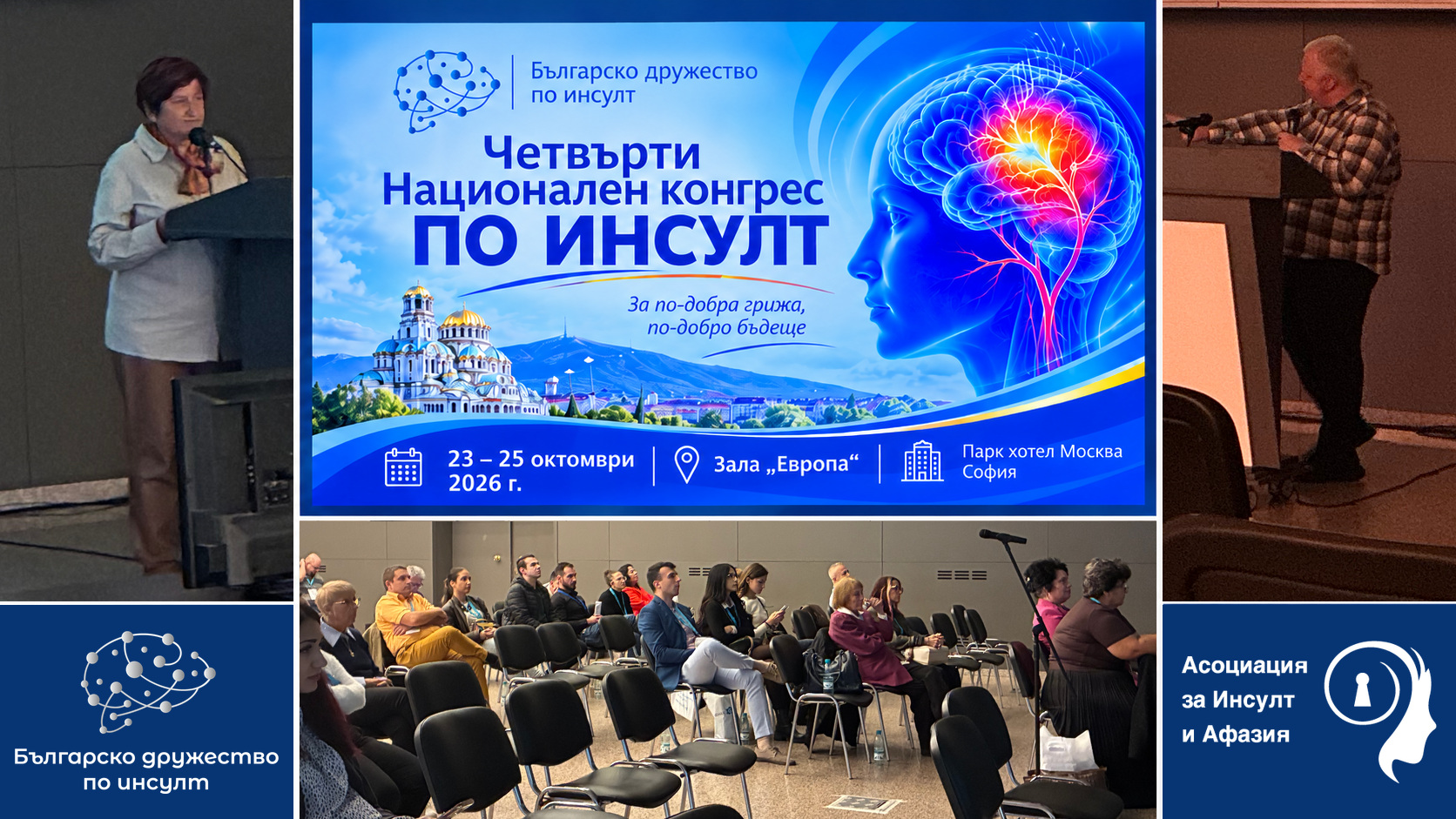
The Fourth National Stroke Congress brought together modern medical expertise and patient experience around a common task – better care throughout the stroke journey. In the patient panel, the Stroke and Aphasia Association presented what has been achieved, the scale of unmet needs for speech therapy and two directions for development: innovations created with the participation of patients, and continuous access to information through the national helpline.
From 23 to 25 October 2026, Sofia hosted the Fourth National Stroke Congress of the Bulgarian Stroke Organisation (BSO). The program linked the organization of emergency treatment, modern therapeutic approaches and recovery with the issues that remain for the patient and the family after discharge.
The Association for Stroke and Aphasia (ASA) has been partnering with BSO for four years now in efforts to improve care. Just days before the congress, on October 20 – World Aphasia Day, the partnership received a new practical dimension with the signing of a memorandum of cooperation, which also included the University General Hospital for Active Treatment "St. Anna" – Sofia AD (University Hospital "St. Anna" – Sofia). The hospital operates the country's first high-tech stroke treatment center.
The agreement formalizes the common work for people with aphasia. Under it, patients will be able to be referred directly from hospital treatment to the Centers for Speech Therapy for Aphasia (CSTA) for free therapy. The parties will also partner to improve the quality of care provided, develop expertise and better coordination.
For families, this means a clearer next step at a time when the most important question often lacks an answer: "After the hospital, where?"
{photo]
INTERNATIONAL EXPERTISE AND ATTENTION TO RECOVERY
The congress program covered 13 thematic forums. Under the general question "Stroke network – a step forward or a trap?" the participants examined the organization of treatment, thrombolysis, endovascular interventions, neurointensive care and the interaction between neurology and cardiology. Medical law, risk management, diagnostic capabilities and conditions that require continued care after stroke were also discussed.
There was strong international participation in the forums for personalized rehabilitation. Specialists from universities in Greece presented the application of neuroimaging and neuropsychological markers, transcranial magnetic stimulation and gait analysis. Experience from Prague, Germany and the UK completed the conversation about the organization of treatment, biomarkers and spasticity therapy.
An important speech therapy focus was the topic "From the severity of aphasia to the individual language profile: clinical significance for speech therapy assessment" by Assist. Assist. Dr. Emanuela Shchika and prof. Dr. Katerina Shtereva from Sofia University "St. Kliment Ohridski". She drew attention to the need for assessment and therapy to take into account the specific language profile of the person - his difficulties, preserved abilities and communication needs.
Speech therapists and trainees from CSTA also took part in the congress. For them, it was an opportunity to receive up-to-date information about the different medical and therapeutic perspectives on stroke. The meeting with the expertise of Bulgarian and international specialists upgraded their knowledge and enriched their understanding of the relationship between acute treatment, recovery and speech therapy. This participation contributes to the development of their professional competence and better coordinated care for people with aphasia.
This individual perspective was continued in the patient forum "Stroke and Patients", moderated by Assoc. Rosen Kalpachki. It was there that ASA presented how medical care can be related to affordable therapy, family support and long-term participation of patients in creating solutions.
{photo]
DORINA DOBREVA — HOW PERSONAL EXPERIENCE TURNS INTO PUBLIC SUPPORT
In the opening presentation "From personal pain to systemic change", Dorina Dobreva traced the path from her mother's stroke to the creation and development of ASA.
The story put the family's experience at the center. After a stroke, loved ones take on new responsibilities — care, organizing recovery, searching for specialists and information, helping to communicate. This often happens in conditions of uncertainty, fragmented services and strong emotional load.
From this necessity was born the idea of the Association: the accumulated knowledge, experience and support to reach the next families so that they can go through the recovery more confidently.
The presentation outlined the specific dimensions of this work: the national stroke support line, 50,000 free copies of the "Post-Stroke Handbook", support groups, volunteering and building partnerships between the patient community, medicine and institutions.
Initiatives that expand access to knowledge and communication were also presented, such as the Viber information bot, the free I Communicate app, educational activities on prevention and health literacy, as well as opportunities for art therapy and therapeutic gardening.
A special place was given to the international recognition for this work: the distinction of Dorina Dobreva among the winners of the "20 Voices Award 2026" of the World Stroke Organization. In the presentation, the recognition was shared with the ASA team and the Bulgarian patient community.
The general message was consistent: the patient experience is knowledge that should be involved in the development of services and policies. A saved life needs conditions in which a person can regain their independence, communicate and maintain their place in the family and society.
{photo]
SPEECH THERAPY — A WORKING MODEL IN THE FACE OF A NEED ON A MUCH LARGER SCALE
The presentation on the Program for the Construction of Speech Therapy Centers for Aphasia for the period 2025-2030 showed how a community need can be turned into a concrete municipal policy.
At the heart are identified problems: insufficient awareness of aphasia, lack of consistent referral to a specialist and limited opportunities for affordable therapy. The program combines funding and control by Sofia Municipality, academic expertise and training of personnel from Sofia University and organization, coordination and development of the ASA network.
How big is the need that this model has to meet?
According to the data presented by the National Center for Public Health and Analyses for 2025, 49,307 cases of stroke were reported in Bulgaria, of which 47,971 were hospitalized. Ischemic strokes are 45,361, or approximately 92% of all reported cases. 4,873 deaths among hospitalized people are indicated.
These numbers describe reported cases, not necessarily individuals. However, they do indicate the extent of the disease and the need for organized care after the acute phase.
In the presentation, a forecast estimate is made for Sofia by applying the national frequency to the population of the city. It outlines approximately 9,302 stroke cases per year, of which about 8,383 cases experienced the acute phase. With the assumption of aphasia used in the analysis, this means potentially about 2,515 new cases of aphasia per year among those who have experienced the acute phase in Sofia.
This is a needs assessment, not a direct census of diagnosed patients with aphasia in the capital. The estimate is an important benchmark for the planning of services.
Against this background, the presented capacity for the four units at the stage of development under consideration is about 280 people per year, at an estimate of approximately 70 people per center. Compared to the estimated 2,515 new cases, this means only about 11% of potential annual coverage.
In other words, even with the full use of this capacity, the service could cover approximately one in nine new cases. And outside this calculation are people with aphasia from previous years, who also need therapy.
It is here that the value of the established centers and their extremely insufficient coverage in relation to the need are seen at the same time. For the people who reach them, they provide a real opportunity for free specialized assistance. For the city as a whole, the data show the need for consistent expansion of the network and the training of more specialists.
The program envisages the construction of 10 centers and sets a goal to reach therapy for 20% of new cases of aphasia in Sofia annually. Along with direct work with users, it creates a basis for practical training, mentoring and applied science.
Direct referral from the hospital to the CSTA is an essential step in this direction. In order to have a full effect, it must be accompanied by sufficient capacity for admission and continuing therapy.
ORRY – PATIENT CARE AND THE WAY WE CREATE FUTURE INNOVATIONS
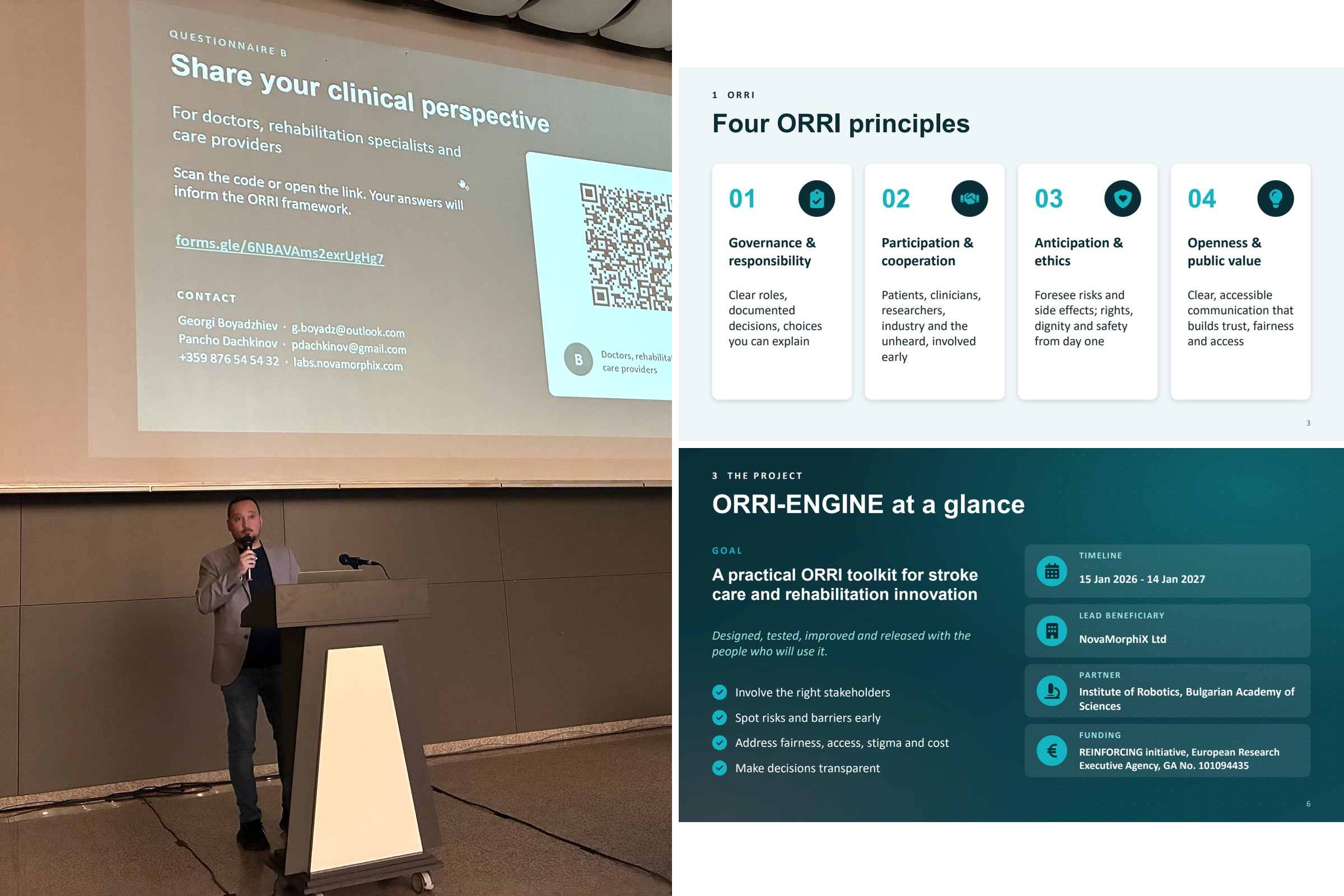
The ORRI-ENGINE project, presented by Eng. Georgi Boyadzhiev from NovaMorphiX, drew attention to a longer-term task: future solutions for people with stroke and aphasia to be created in such a way that they actually reach them and serve them.
The leading organization is NovaMorphiX, and the partner is the Institute of Robotics at the Bulgarian Academy of Sciences. The collaboration with the ASA and the participation of teams from the Center for Disease Control and Prevention and people with aphasia connect the development work with the real conditions of recovery and everyday life.
OPRI stands for open and responsible research and innovation. The approach involves patients, relatives, therapists and other stakeholders in the formulation of the problem and the development of the solution.
This changes the issues on which an innovation is evaluated. In addition to whether it works technically, it must be established whether the person can use it with their motor, language or cognitive difficulties; whether the design allows adaptation; whether the price is bearable; whether the solution is applicable at home and in therapeutic practice; whether it reduces dependence on other people's help.
Aids created by 3D printing are a practical way to discuss and check these issues. The user can show what is inconvenient, what makes it difficult to install or use it on its own, and what change would make the product useful.
A significant result of the project is the development of a methodological framework and questionnaires for collecting the views of patients, families, specialists, organizations and institutions. Through them, the Bulgarian team contributes to the European exchange of practices for responsible innovation.
The ambition is that this toolkit can also be used by other teams and future projects. Thus, the experiences of people with stroke and aphasia can influence further developments – even before key decisions are made about their form, function, price and accessibility.
This is patient care with a long-term perspective. It seeks a change in the development process itself so that solutions tailored to the capabilities and needs of the people for whom they are intended reach the market.
'SUPPORTED AFTER A STROKE' – THE NATIONAL LINE EXPANDS ACCESS TO ASSISTANCE
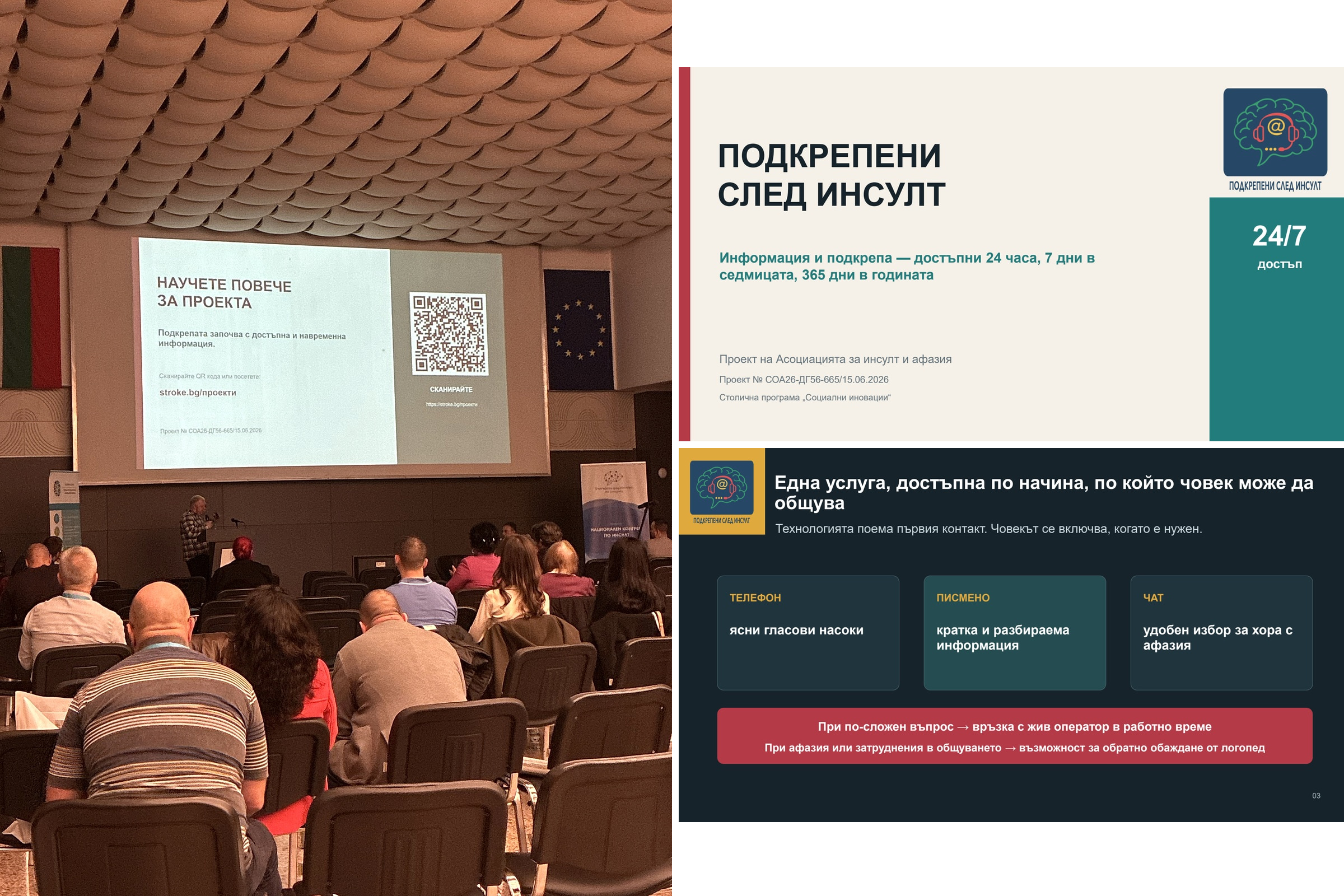
The project "Supported after a stroke", implemented under the Sofia Social Innovations Program, builds on the national support line of the ASA through a specialized service for information and guidance by phone, email and chat.
The change is for access to basic information and supporting resources to be uninterrupted – 24 hours a day, seven days a week, 365 days a year.
During the working hours of the service, a live operator will take over the inquiries and assist in guidance. Outside of it, the initial information will be provided by an artificial intelligence agent who is being developed on the project. For more complex issues, the model provides for the involvement of a human and a connection with an appropriate specialist.
This corresponds to the real rhythm of needs. A loved one may seek information in the evening after sudden hospitalization. A patient may wake up early, anxious about impending discharge, and have questions about the next steps. A family may need guidance for rehabilitation, speech therapy, or supportive resources over the weekend.
In such moments, the opportunity to receive understandable information has immediate value: it helps to sort out your questions, understand opportunities and orient yourself to appropriate help.
Particular attention is paid to people with aphasia. Accessibility for them requires adapted ways of understanding and expression, resources for assisted communication and the ability to call back from a speech therapist. Thus, the language disorder is taken into account in the organization of the support itself.
The innovation is in the qualitative change of the service: the national line expands the time and channels through which one can access information, while keeping human participation where it is needed. Round-the-clock automated information and the work of the operator have different, complementary roles.
The pilot project includes the development of a methodology, accessible bilingual content, channel integration and testing with real inquiries and feedback. After the pilot phase, the service is envisaged to become part of the permanent activity of the ASA.
TASK-SPECIFIC PARTNERSHIP
The patient panel at the congress traditionally attracted serious interest from specialists from all over the country. The presentation showed both the progress and the distance between the available support and the actual need.
The ASA and BSO have specific common tasks: earlier recognition and referral of people with aphasia, continuity between hospital treatment and therapy, expansion of the capacity of services, training of specialists and evaluation of results. To these is added the participation of patients in the creation of new solutions and the provision of information in time and in the way they need it.
The four-year partnership between the two organisations shows how active, consistent and result-oriented work can translate these tasks into concrete actions.
On the eve of World Stroke Day on October 29, the congress reminded: saving lives and supporting life after a stroke are part of a common responsibility. It includes the opportunity for the person to receive treatment on time, to reach recovery and to have support to communicate, choose and participate.