

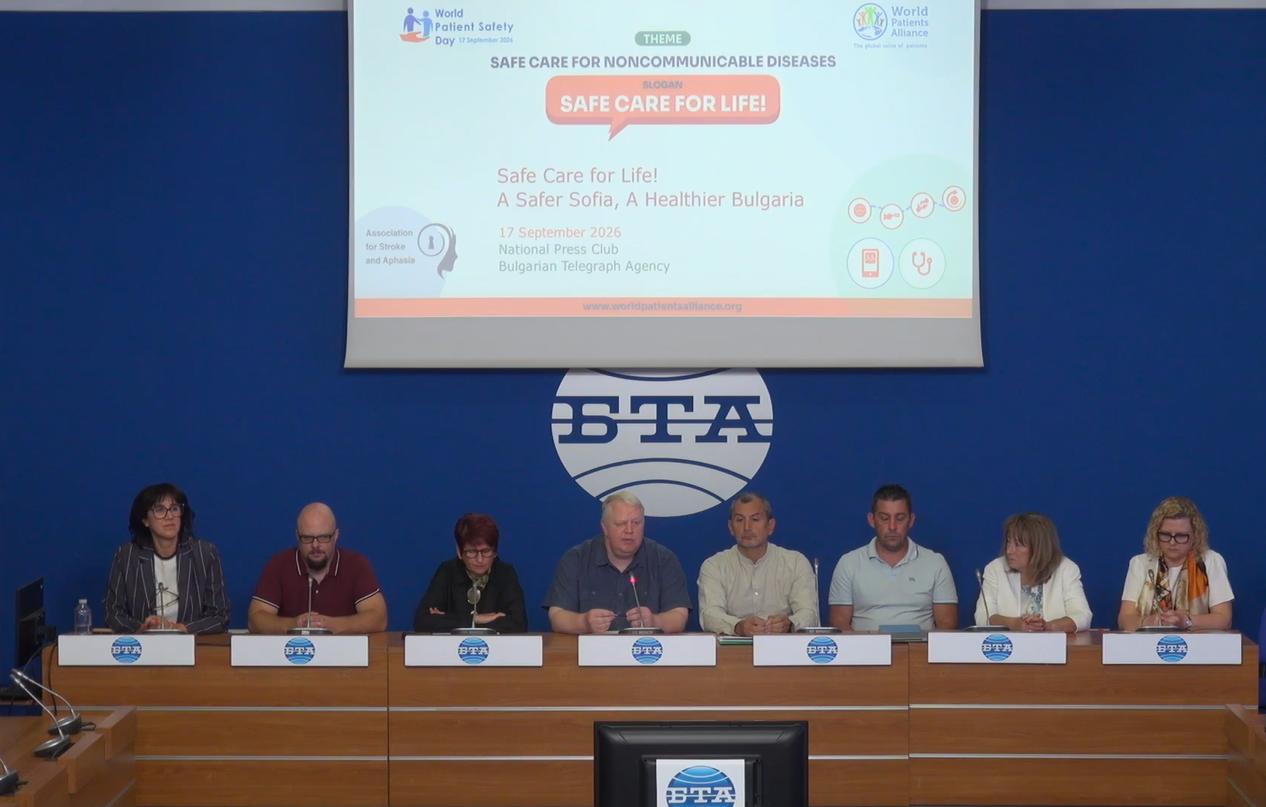
Patients need support throughout their care journey, from prevention and diagnosis to treatment, recovery and everyday life with a chronic condition. This need brought together the participants in a press conference organised by the Association for Stroke and Aphasia on 17 September 2026 at the Bulgarian News Agency’s National Press Club in Sofia. Held under the heading “A Safer Sofia, a Healthier Bulgaria. Safe Care for Life”, the event explored patient safety from the perspectives of patients, healthcare professionals, social services and local government.
The discussion highlighted the importance of the connections between services. What happens after a person leaves hospital? Who follows their recovery? Do they understand their treatment instructions? Where can their family turn for help? Participants identified these transitions as a shared challenge for people living with chronic noncommunicable diseases.
Dr Georgi Georgiev, Vice-Chair of the Association and moderator of the event, addressed the fragmented efforts across healthcare and social care. He stressed the need to connect existing resources and involve patient organisations in developing solutions. The proposed approach is to establish a practical model of coordination in Sofia, linking medical treatment, rehabilitation and social support around the needs of the individual.
Anna Stoykova, a member of Sofia Municipal Council, presented a concrete example of such cooperation. The programme to establish speech and language therapy centres for people with aphasia is delivered by Sofia Municipality in partnership with Sofia University “St. Kliment Ohridski” and the Association for Stroke and Aphasia. Centres are already operating at Diagnostic and Consultative Centres 12 and 17, providing therapy free of charge to patients. Further centres are being prepared. Stoykova explained that bringing together municipal support, professional expertise and a patient organisation provides a foundation for extending this model nationally.
“Difficulty speaking does not mean you have nothing to say,” stressed Dorina Dobreva, Chair of the Association. She focused on communication as an essential part of patient safety. Aphasia does not mean a loss of intelligence or an inability to take part in decisions about treatment. It can, however, make it difficult to report pain, an adverse reaction to medication or an instruction that has not been understood. Patients may therefore need more time, adapted information, visual aids and a check that they have understood what has been explained.
The Association’s message is that every patient should leave hospital with a clear, understandable plan for the next steps. Families need guidance on whom to contact, where rehabilitation is available and how to support their relative. Their experience should inform policies and services from the outset. Patient organisations can identify risks and help develop practical solutions, but sustainable care requires institutions to take responsibility and work together.
Dr Filip Aleksiev, Chair of the Bulgarian Stroke Society, considered the issue from the perspective of a doctor treating a patient during the acute phase of stroke. Efforts to limit the consequences of stroke need to be followed by long-term rehabilitation and follow-up. He highlighted the need for better communication between hospitals and the services that take over the patient’s care. Speech and language therapy centres can help monitor the recovery of communication and strengthen this connection.
Associate Professor Mihail Okoliyski of the National Center of Public Health and Analyses emphasised sustained public policy, prevention and continuing care. He also drew attention to psychological support, which is often overlooked: support for patients, their families and the professionals working with them. Long-term caring responsibilities can isolate relatives from employment and social life. Supporting them is therefore part of a comprehensive response to the condition.
Hristina Panteva of the Agency for the Quality of Social Services presented the social care perspective. She outlined the opportunities for a comprehensive, integrated approach and the pressure placed on social services when post-acute care, rehabilitation and palliative care are insufficient. Her contribution underlined the need for healthcare and social care to develop coordinated responses, so that a person’s needs do not fall between the responsibilities of different systems.
Minka Yovcheva of Sofia Municipality stressed that local authorities are closest to people’s day-to-day difficulties. Cooperation between the municipality, the academic community and the non-governmental sector is already demonstrating the value of joint action. The next step is to make effective services available to more people and ensure that patients and families can find information about the support available to them.
Physiotherapist Stoyan Stoev focused on early care and rehabilitation after stroke. He highlighted the importance of working with patients from the beginning of their recovery and using approaches that can help reduce subsequent complications. His contribution reinforced the discussion’s central message: each stage of care matters, and its benefits depend on timely action and continuity with the next stage.
The declaration presented at the event calls on the Ministry of Health, the Ministry of Labour and Social Policy and Sofia Municipality to work together with patient organisations. It proposes an integrated system for safe care in Sofia, sustained cooperation between sectors and the establishment of a Sofia Forum for Safe Care for Life. The forum would develop practical recommendations on prevention, coordination, rehabilitation, follow-up and community support, with patients and families actively involved in shaping policy.
For the Association for Stroke and Aphasia, this initiative is an opportunity to turn shared concerns into joint action. Safe care means knowing what comes next, being able to communicate one’s needs and receiving support that continues beyond hospital treatment. Sofia can become a place where this approach develops into a working example for the rest of Bulgaria.
Read the full declaration published by the Bulgarian News Agency — in Bulgarian
Watch the full press conference recording on BTA — in Bulgarian with autotranslation on any language.